18 Conflict Resolution/Meditation/Negotiation Models
By Peter J. Jessen
1998-2000; last edited 7-18-01
(Copy sent to MN legislature,
House Speaker, Steve Sviggum and Senate President Roger Moe and others:
Roy Terwilliger, Larry Fitzgerald, John Marty, David Jennings, Otis Courtney,
Sarah Psick, Victor Moore, Tom Hanson)
In 1998, the set consisted of 5 macro models.
In 2000, an additional set of 5 was added, of micro models.
In August of 2001, the documents included 7 each micro and macro for 14
models.
Just before 9/11/01 one more macro/micro model was added, and again a
set after 9/11.
These models have been rendered all the more relevant in light
of 9/11/01.
The original 5 models were developed for the June 2000 "Columbine P.S." paper on education, on this web site. These models are for use in conflict resolution, to enable the establishing of dialogue between all stakeholders by enabling them to conduct their own dialogue marathon: 8 at the macro-societal and institutional level, and 8 at the micro-individual level for use in face-to-face encounters, whether the other individual(s) does or does no represent a larger institution of society. These models can be used to avoid what is often a disastrous swing of the pendulum, in order to enable all involved to use what is described below as a “calculus of meaning” and a “calculus of pain” to assist in their deliberations.
As before, the models are for use in conflict resolution, to enable the establishing of dialogue between all stakeholders by enabling them to conduct their own dialogue marathon: 9 at the macro-societal and institutional level, and 9 at the micro-individual level for use in face-to-face encounters, whether the other individual(s) does or does no represent a larger institution of society. These models can be used to avoid what is often a disastrous swing of the pendulum, in order to enable all involved to use what is described below as a calculus of meaning and a calculus of pain to assist in their deliberations. Our list began with five total. Now we have identified 9 each of macro and micro models:
Macro:9 Macro (institution to institution) Models
9 Micro (face to face) Models
- By Rome in Palestine, Romans vs. Zealots at Masada
- Germany after World War II: The Evangelical Academies
- South Africa, to end apartheid: Joint mediation
- The Oslo Accords Process for Israel and the Palestine Authority
- The "Politics of Love" of Michael Cassidy in South Africa
- The 1975 Helsinki Accords, helped end Soviet Union with human rights
- Third track diplomacy of The Roman Catholic Church
- Round Table of Wash. Post's K. Graham of high ranking individuals on an informal basis
- The Ubuntu Theology of Reconciliation model of South African Archbishop Desmond Tutu.
Micro:
- Conflict resolution collaboration chart of Ken Thomas' empowered negotiation
- 2 x 2 probability of outcome matrix of Mary Pipher
- Using selftalk, and the CO2RE/LEAD formulas to raise Adversity Quotient (Paul Stoltz) to enable "Learned Optimism" to overcome "learned helplessness" (Martin E.P. Seligman)
- "Managing Conflict for Individual & Team Success At Home and At School," by Sam Imperati and JoAnn Houck
- Use of Lists/Recipes to Empower both sides, making sure that, in Donald Meichenbaum's word, all that can be is "negotiable"
- Passover Mandate of Jesus to love one another
- Passover Mandate of Jesus to serve one another
- Round Table of Wash. Post's K. Graham of high ranking representatives of Institutions, on a formal basis.
- The Arendt Concept of Reconciliation of Jewish
scholar Hannah Arendt.
Regarding the 18 models of conflict resolution
These 18 show how we can both understand conflicts and develop workable
resolutions for solving them, whether personal (micro) or between larger
aggregations of individuals in the institutions and nations of society
and the world (macro).
Peter Berger has coined, among many highly useful terms, this pair: "historically
specific conservatives" (those of the left or right who would
usher in their desired type of society and then freeze it in place) and historically nonspecific conservatives" (those who accept
change and make haste slowly). I find them so much more useful as
a way of looking at the ideological landscape (as it cannot be avoided).
As I also state on those pages, this and another pair of Berger's analytical
word tools,"calculus of meaning" and "calculus of pain",
are, in my judgment, the critical one- two punch of analysis and conflict
resolution. They are two of the four key organizing principles for
dealing with such conflict resolution, along with the concepts of "lists/recipes"
and collaboration. "Recipes" comes from Berger as well,
through Alfred Schutz. All of which I would make a part of what
Cassidy call the politics of love, "which has to be both the umbrella
over and foundation under all discussions and interactions if true conflict
resolution is to be achieved in a way that love and justice pervades and
is received and perceived by both sides." These models are
of particular importance and relevance in the continuing conflicts in
the world today, whether by nation-states or independent groups dedicated
to changing society through violence.
- Masada, a "how NOT to work things out.
It is a story set in Palestine/Israel of 72 A.D. It is a story
of the failure to attempt or trust mediation (although it is not known
if any was attempted). The Zealots, on top of the 1300 foot plateau,
were unable to prevent the Romans' slow, methodical, progress of building
a ramp to the top of the sheer cliff in order to breach their defenses
(FN#13). It is a lesson in both international and local politics
and an opportunity to understand our own behavior better. "Masada"
was a four part ABC Novel for Television, April 5-8, 1981. Having
people watch the video tape would be an excellent dynamic. CIS
(Cultural Information Service), in NYC, wrote a marvelous study guide
for it, that stands alone as a guide to any discussion regarding conflict
resolution, peace, etc., as well. It is 15 pages, with pictures,
on 11x14 paper (FN#14)
- "The Evangelical Academies" model
of post World War II West Germany, where the mediator is the faith community,
discussed in the book Confession, Conflict & Community. They
were established by the faith community. In a word, unlike Humpty
Dumpty and all the king's men, they were able to help put West
Germany back together again, as "the academies played a singular
role in restoring the democratic idea after the disaster of the Third
Reich." "The Evangelical Academies" have been in
continuous use, and were central to the recreation of West Germany.
These "academies" provided a sense of dialogue between all
the parties, fostering and enabling a kind of "mediating action"
to take place between the social and political forces (not as in arbitration
or in seeking compromise, but rather in the sense of creating a "zone
of freedom" in which the concerns of all sides could be brought
to bear upon the urgent issues before them, using a set general process
agendas in which the specifics could be discussed and dealt with by
all concerned. The meetings were held outside the cities in the
country side, with minimal distractions, and always with a mixed group
of stakeholders. The first conference brought together "150
lawyers and economists" and later ones "laborers, farmers,
physicians, and social service workers--people from all walks of life."
A key lesson learned was the importance and "necessity for each
occupational group within the framework of modern society to encounter
the group that it most complained about." (FN#6)
The academies continued through the decades, with problems addressed ranging from road locations to international issues of concern. 19 Academies continue today under an umbrella association, and is working with similar movements in Africa, Asia and America. They were also used in East Germany to give citizens a place to gather and discuss prior to the fall of the Berlin Wall (prior to which over 1,500 conferences were held each year), and then used later to help in the reunification of West Germany and East Germany after the fall of the Berlin Wall. (FN#7) Why not regarding education in America?
- The mediation model used in South Africa.
The model is outlined as a theoretical piece as well as being discussed
in the practical terms of its actual use in this setting. The
1989 book The Passing Summer : A South African's Response to White Fear,
Black Anger, and the Politics of Love, by Michael Cassidy, discusses
the situational complex of apartheid in the summer of 1986, including
the several centuries of actions that led to apartheid. The actual
South Africa mediation model is outlined in the 1988 book A Future South
Africa: Visions, Strategies, and Realities, edited by Peter L.
Berger and Bobby Godsell. On page 320-321 of the Berger-Godsell book
is the "Analytic Scheme" for guiding the research and, on
pp. 322-323, is Peter Berger's outline for "reality-testing"
what is being done. The change in South Africa, as anywhere else,
did not "just" happen. The Berger-Godsell report was
released in 1988, two years before Nelson Mandella was released from
prison, who was then elected President in 1994. After 1988 and
1989, the contents of these two books merged in the conferences that
were held to discuss the transition out of apartheid.
In an update received from Bobby Godsell in March 2000, he discusses four additional conferences which were particularly helpful, conferences which bear witness to how well this model can be used successfully all along the spectrum of stakeholder positions. The four conferences were: (1) 1989, called by the then new Afrikaner Nationalist president, FW de Klerk to address the problems of political violence (which the African National Conference boycotted); (2) 1994: called by a Kenyan Bishop which resulted in involving the Inkatha Movement, led by Mangosuthu Buthelezi, just weeks before the first democratic election in 1994, enabling it to join the now cooperating ANC and de Klerk government; (3-4) the use of the "reality testing" model of the referenced 1988 book by groups on the far right and left: by the Broederbond, a secret Afrikaner Nationalist intellectual organization, led during this critical period by J P de Lange, and by the South African Communist Party. Of these latter two, Bobby Godsell states, "In both cases they concluded that [their old] strategies were not possible," and thus they too joined to work cooperatively with the other stakeholders regarding South Africa's development" (FN#11). And such mediation continues.
Godsell also reports (FN#9) that "Evangelical Christianity continues to play a surprising role in providing a common road to modernity for black and white, left and right" (FN#10). It is the "common road," properly given a "realty testing," which provides its users with a peaceful outcome as well as opportunity to move toward a more just one. Perhaps the title of Michael Cassidy's book shows us why it worked in South Africa and why it can work in education in the United States: The Passing Summer : A South African's Response to White Fear, Black Anger, and the Politics of Love. Fear and anger clouded both the presentation of issues and judgment about them. Love, in the form of the Golden Rule, was used. Love, however defined, whether in terms of civility of discourse, civility in relational interaction, or both, can enable the Archimedean lever of mediation to enable the resolution of the problems to the satisfaction of all stakeholders.
- The Oslo Accords Process being used in the Middle
East to resolve the conflict between Israel and the Palestinian Authority
was begun in the woods of Norway. See The New Yorker article,
Annals of Diplomacy section (Dec. 20, 1993, pp. 77-85): "THE
PEACEMAKERS". Subhead: "In Norway, two Israeli
academics [the initial mediators] worked for months to broker the secret
peace--and succeeded where governments had failed." The initial
success of what is being called "The Oslo Accords" has come
about because both sides agreed to leave the most contentious issues
until last (West bank, the final settlement of Jerusalem, and full sovereignty
passed to the Palestinian Authority, or "PA", among others
of the most thorniest issues), so as to work on the areas on which there
either was agreement or clear room for negotiation. The theory:
that the process of working together would enable both sides to become
familiar with each other, break down the walls between them, and develop
a kind of trust that would enable them, after resolving the "are
negotiable" issues to finally tackle the major issues separating
both sides, issues which were originally labeled "non-negotiable."
Theory problem: unlike with West Germany and South Africa,
a common faith bond between the two sides is missing. Rather than
gradually reconciling with each other (made possible by the use of love,
the basis of any faith community context), the process has been one
sided, without reconciliation because of the continued propaganda of
hate and fanatic Islamism, which has been the staple of the Palestinian
culture since the creation of the Jewish state in 1948, and the demand
from certain Israeli elements of a restoration of Israel as in Biblical
times. The irony is that the Masada roles are now reversed.
The Palestinian Authority is acting the role of Rome wanting the Israeli's
to act the role of the 1st century Zealots and kill themselves.
In its current state, this model is actually moving toward the Palestinian
goal of a Masada-like conclusion.
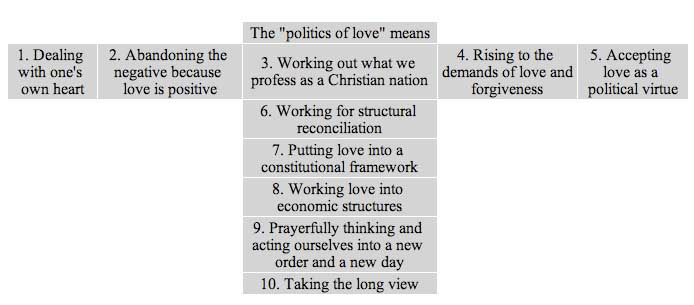
To put it bluntly, the "Oslo Accords" need the "politics of love" (Model #5 below) if the negotiators are to avoid the Masada affect. The empirical reality is that the presence of the acknowledgement of love in Models 2 and 3 were successful, and that its absence led to the failure of #1 and is leading to the failure of #4. #5 organizes this principle for any macro-level conflict negotiation.
- The mediation model based on Michael Cassidy's "The Politics
of Love," in his book The Passing Summer : A
South African's Response to White Fear, Black Anger, and the Politics
of Love.
Cassidy proposed this model for South Africa, with the urging that it be incorporated in the country's constitution. As 78% of South Africans (Black and White) professed to be Christians, the politics of love followed their shared belief that "God is love." The model served as an inspiration to themselves regarding letting their better natures prevail as continues to serve as in inspiration to other peoples of the planet caught in the same kind of process. The model is also practical, in that "the golden rule is finally what life is all about" and is at the heart of every major world religion and most secular philosophies. But how does a nation or large institution incorporate the golden rule all claim to want to follow but find so difficult to follow? Through love, which turns revenge into treating perpetrators of prejudice with the respect and civility. Cassidy regarding meetings with the head of detentions: "I grasped afresh that South African blacks, and especially black Christians, are in many ways incredible. Their capacity to bear pain, to tolerate indignity, to dredge up new goodwill from who knows where and still be gracious, never ceases to amaze me" (p. 19).
Cassidy discusses his ten point model in detail in his book's Part Six, "The Politics of Love (The outworking of love as a valid political principle," in three chapters, Chapter 19 ("Winning in the World's Workshop" based on the Swiss Hans-Ruedi Weber referring to South Africa as "the laboratory of the world," in 1973, for how they did would greatly affect the world's belief in what is possible), Chapter 20 ("Love as a Political Virtue" which is to sing songs Cassidy doesn't mention but which relate, the Dianne Warwick song "What the world needs now, is love, love, love", or the song made popular world-wide by Michael Jackson and Pepsi Cola about the world needing love or Disney's "It's a Small, Small World After All"), and Chapter 21 ("Love in Structures", as in the constitution, etc.).
The 10 point model proposed in 1988 by Cassidy, p. 425, which is needed by those involved in The Oslo Accords and any other global "hot spots" needing conflict resolution, is:
In her book, The Human Condition, the Jewish scholar Hannah Arendt says we keep chaos at bay by keeping promises and that we deal with the irreversibility of our words and deeds through forgiveness, that forgiveness and reconciliation are not the provenance of Christians, although Jesus emphasizes it more than anyone, but rather that both are necessary because of the "human condition." To forgive in order to be reconciled requires loving. Love is what is missing in the Middle East with the Oslo Accords. Without love, it will ultimately fail. Love and reconciliation are a necessary part of the human condition.
Macro models 2, 3 and 5 show love as a key ingredient for macro conflict resolution. Models 1 and 4 suggest that its lack prevents resolution. There is the evidence of another contemporary, long term, unresolved, unreconciled, loveless conflict: Korea. The unsuccessful threatening Cold War rhetoric of Washington has not worked. The recent summit between North and South Korea was brought about by South Korea's Kim Dae Jung, using a mix of Christian compassion and Confucian sincerity. If this continues, this country could also be reconciled, using the "politics of love."
- The 1975 Helsinki Accords, In terms of the
Helsinki Accords, I would juxtapose them with the Oslo Accords as well
as with Masada, both of which failed (interestingly enough, both failures
were in the Middle East), as I predicted in the items I'm sending to
you, as both Oslo and Masada were unable to either recognize and/deal
with hate and mistrust, and neither was able to view with love.
According to Natan Sharansky, the signing of the 1975 Helsinki Accords
by the Soviet tyrants was when they "signed their own death warrant"
("Why Weren't the Helsinki Standards Also Used for Oslo?"
Wall Street Journal, May 14, 2001, p. A18). This "third basket"
meant the Soviets and their puppets were agreeing "to uphold
the basic human rights of their own subjects", although they had
no intentions of doing so. But this was the "Achilles' heel
of the totalitarian state" as all actions were then scrutinized
by world opinion according to this agreement (that, plus going bankrupt
trying to keep up the arms race, while also intervening militarily in
Vietnam and Afghanistan). The "Kremlin eventually buckled
under the strain," as, "forced to relax their tyranny, they
released a spark of freedom that spread like a bush fire and burned
down an empire", a reminder from the East to the West that "freedom
has the power to change the world." Sharansky
says the real lesson lost by the Oslo accord folks was that the Soviet
"historic collapse was shaped by the moral authority of dissidents"
in Russia and the moral authority of certain political leaders in the
U.S. willing to use the phrase "evil empire," which brought
near apoplexy from the left in this country. Sharansky's bottom line:
"the Oslo accords failed to establish any connection between human
rights and the Israeli-Palestinian peace process."
- The third track diplomacy contributions and structures
of the Roman Catholic Church, especially in Mozambique, Central and
South America, and South Korea. Berger reminds us that the U.S.
population as a whole is as religious as India whereas the political
and academic elites are as secular as Sweden. This explains to
me why they can't deal with morality, as it would be a foot in the door
for religion, and religion must be stamped out at every point (see comment
on Voltaire below). And religion, more than any other, teaches
morality and love. The recent (1999) book edited by Peter Berger,
The De-secularization of the World: Resurgent Religion and World
Politics, includes a piece by George Weigel, "Roman Catholicism
in the Age of John Paul II." In it he discusses what John
Paul II has done as well as the "third track diplomacy" of
the Rome-based San' Egidio Community, which he says has played important
roles in 3rd track, "most successfully in Mozambique."
Another major difference is the lack of a concept of sin on the political left, for if there is no sin, how can what one is doing be all that wrong? The moral strength of Gandhi in India was not his but England's self image as a moral nation, sinful though it may be, but one that didn't slaughter people, and thus had to withdraw on those moral grounds (a concept totally missing, of course in the Soviet Union and any past and present Marxist states). Ditto in South Africa: it was the vision of people, Black and White, both Christians, that enabled apartheid to be put back in its box. The key now is to prevent its reverse. And the civil rights movement in this country was also fought on a moral base. Martin Luther King could not have been as effective as he was, nor the supreme court able to rule as it did, if it wasn't for the moral sense that counted, the moral sense of everyday Americans, who were revulsed by such scenes as Bull Connor's dogs and the beating of unarmed, peaceful marchers, not to mention the bombing of little girls and the lynching of innocent men, and who said, "but that is not us," ushering in the change. What nation can survive without such a moral base as it relates to its citizens and to its fellow nations?
But even in moral nations, we need the "politics of love" (sin, and all that, one must recall, aren't going away). Too many seem to have Voltaire's wish. Weigel writes that Voltaire "died with the wish that the last king be strangled with the guts of the last priest." For all of his defense to the death of one's right to speak their opinion, "the revolution he helped to inspire defined its goal as little less than the overthrow of the civilization the Church had helped nurture for centuries." When I was in graduate school, those of my fellow grad students who were Marxists told me I would be one of the first ones shot come the revolution (which they sincerely believed would come). I said yes, but you'll be beside me, as the first to go are the intellectuals. Graduate school in the classroom with Berger was exciting, but with fellow grads disappointing. The left is so lacking in balanced morals (and the concept of "moral equivalency negates morals, making what is moral what one personally feels to be moral, i.e., anything anyone does). But how can you have a sense of morals that is all encompassing of all people if you don't have a concept of sin and therefore believe any action of one's own cannot, by definition be wrong? If one thinks it OK it is by definition OK, as seen by those who are historically specific conservatives on both the left and right.
- Putting top representatives of conflicting organizations in the anchoring
environment of a Round Table, as was used by King
Author for his Knights of the Round Table, in order to get them to act
cooperatively together, and as was used by Katherine Graham, Publisher
of The Washington Post, to foster open communications where suspicious
communications existed before (just as its counter part, #8 in micro,
is on an informal basis).
- The Ubuntu Theology of Reconciliation model
of South African Archbishop Desmond Tutu. Tutu's theology is seen in
the title of this book: No Future Without Forgiveness. Additional understanding
can be gained from the book Reconciliation: The Ubuntu Theology of Desmond
Tutu by Michael Battle (1993). Additional books of value include The
Passing Summer: A South African's Response to White Fear, Black Anger,
and the Politics of Love, by Michael Cassidy, A Future South Africa:
Visions, Strategies, and Realities, edited by Peter L. Berger and Bobby
Godsell (1988). Tutu says "We have got a thing which we call ubuntu,
which means humanity.. For Tutu, Ubuntu really means that "I am
because you are. We belong together. Our humanity is bound up with one
another. We say in our languages, a person is a person through other
persons. A solitary human being is a contradiction in terms. I learn
how to become a human being through association with other human beings."
In other words, no matter how appropriate "individualism"
is, "No man is an island," as John Donne wrote. Our independence
is actually interdependence with each other.
Tutu chaired the Truth and Reconciliation Commission which was established to heal the raw wounds of South Africa's past, consisted of three committees: Amnesty Committee, Reparation and Rehabilitation (R&R) Committee and Human Rights Violations (HRV) Committee. Tutu's concern was this: as Apartheid ended, what would keep Whites from withdrawing into armed enclaves and what would keep Blacks from wanting to do to Whites what Whites had done to them? How could they be reconciled? For Archbishop Tutu, one word: "ubuntu: I am because we are... a person is a person through other persons." In fact, it has been such an excellent model of conflict resolution that some hope it will be introduced in Northern Ireland and the Middle East. The Truth and Reconciliation Commission chaired by Archbishop Desmond Tutu heard statements from 20,000 witnesses, some 15 percent in public. Showing reconciliation was possible, the committee proved it by being even-handed: criticizing both the Apartheid regime and the ANC for the excesses of their brutality. You can read more on the official web site of South Africa's Truth and Reconciliation Commission. Throughout, the key is reconciliation. It can be done. It must be done. As with the other macro models, it is worked through at the micro level. We look forward to seeing it applied elsewhere.
The establishment of South Africa's Truth and Reconciliation Commission was a pioneering international event. Never had any country sought to move forward from despotism to democracy both by exposing the atrocities committed in the past and achieving reconciliation with its former oppressors. In 1995, Tutu, the 1984 Nobel Peace Prize Winner was about to retire as Anglican Archbishop of Cape Town when Nelson Mandela asked him to stay on and become the Chairman of the Commission. Tutu argues that true reconciliation cannot be achieved by denying the past. His emphasis: restorative justice over retributional justice. For Tutu, Ubuntu is the African expression that was at the heart of the TRC's labors: "a person is a person through other people." Ubuntu sums up Tutu's philosophical framework for addressing apartheid's hard truths and beginning the reconciliation process necessary to move beyond apartheid's legacy. Human rights, he affirms, cannot stand without Ubuntu's deeper foundation; the future cannot be without forgiveness. He writes: "To forgive is indeed the best form of self-interest since anger, resentment, and revenge are corrosive of that 'summum bonum,' the greatest good."
Kirkus Reviews "No Future Without Forgiveness" which is the "story of South Africa's Truth and Reconciliation Commission (TRC) and a meditation on evil and forgiveness from Nobel laureate Tutu (The Rainbow People of God: The Making of a Peaceful Revolution, 1994). In 1994, South Africa faced a historically unique situation. A long-oppressed majority had peacefully taken power from its minority oppressor. As Tutu explains, the question facing the nation was, What then to do? Should Nuremberg-like trials be held against those who had maintained the ghastly system of apartheid? Or, as many whites wished, should the past be forgotten, let bygones be bygones? The new regime found what Tutu calls "a third way" to deal with the past: the Truth and Reconciliation Commission. Those who had committed politically motivated crimes during the apartheid era would receive amnesty if they made full and truthful public disclosures. In turn, the victims of such acts would be allowed to tell their stories in the hopes that this would restore a measure of their human dignity. Over 18 months some 20,000 victims appeared before the commission, imparting their tales of personal anguishÑof torture, rape, imprisonmentÑbut also exposing a system perpetrated and supported by the highest levels of government, military, and police. No longer could anyone deny knowledge of the past, as so many whites had; never again would such an evil be allowed to exist in South Africa. Yet it would be not only supporters of apartheid answering for their deeds.
Those who had committed crimes in the fight against the system, including Winnie Mandela, would answer for their acts as well. Tutu's writing on this process is nothing short of miraculous. He is strong in his defense of the commission that so many doubted as either too harsh or too lenient. He is also anguished by the depths of human depravity the commission hearings revealed, but passionately hopeful that human caring and unity might prevail, in South Africa and the world. It is ["a] sober depiction and searing indictment of evil and [a] never-maudlin advocacy of love."
Those interested in education in any town or city, are urged to think beyond the conflict resolution process at the institutional level (the 5 macro models above) and think also of the conflict resolution process within their own minds between their "better" and "worse" selves as well as between themselves and those they must resolve conflicts with face to face, at home, at work, or at school (the 5 micro models below). A recommended starting place is to consider either the adoption of one of the following models or the development of another model taking elements from any of the other models, whether approached in terms of outcomes or in terms of personal procedures to follow. These micro, face-to-face relationship models can enable people to approach different tasks using the terminology of the field of conflict resolution, enabling the kinds of effective inter-personal relationships that will foster, support and sustain task completion.
- A full spectrum collaboration model from
lose-lose to win-win, to use as a guide in how well you are doing in
developing a win-win model, with the outcome goal being that of collaboration,
as seen on the following Chart of Win-Lose Strategies for Task Completion/Relationship
Building.
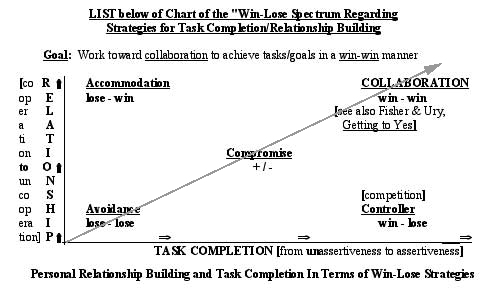
LIST below of chart of the "Win-Lose Spectrum Regarding Strategies
for Task Completion/Relationship Building
Goal: Work diagonally toward collaboration to achieve tasks/goals
in a win-win manner
The previous chart was adapted by Peter Jessen from the model presented
by John Conhere who in tern presented his adaptation of the model of Ken
Thomas, in Conhere's "Peer Mediation" presentation, Fridley
Middle School, Fridley, MN, Jan. 19, 1993, and used by Peter Jessen in
his presentation of "THE MOTIVATION ZONE: Heroes at Work with
Heroes in Training: Background, Rationale and "Curriculum'
For Parents & Kids," before a meeting of the Wilson Cluster
Parent Connection Meeting, Wilson High School, Portland, OR, March 11,
1996, and before the Wilson High School Leadership Group in December 1998.
Key to task success is to understand how to meld each
stakeholder's and stakeholder group's plans, agendas and "to do lists"
into a recipe which includes the concept of collaboration. Following
Meichenbaum's Facilitating Treatment Adherence: A [medical] Practitioner's
Guidebook, by Donald Meichenbaum and Dennis C. Turk; and Meichenbaum
personal statement to Peter Jessen) "collaboration" is further
defined as that which must be understood within the context that no collaboration
can take place unless everything is negotiable. "Non-negotiable"
means conflicts cannot be resolved and collaboration cannot be achieved.
Without collaboration on negotiable items, there can be no Win-Win.
Each group must drop its Wizard of Oz-ian curtains.
Referring to Chart: Left to right = ascending degree of task completion.
Bottom to top = ascending quality of relationships.
Avoidance (not face) = lose - lose.
Accommodates (giving in) = lose - win, as high level of task completion is sacrificed for the sense of relationship.
Controller = win-lose is at the other end of the spectrum is the (where high task completions are obtained by sacrificing relationships). And although compromise has some value, its half win, half lose (not very satisfying to either).
Collaboration is the one that is highest in both relationship building and task completion. Collaboration is the only one which is win-win and the best for long-term win-win. BUT, collaboration only works with that which is negotiable. Caveat: "consensus trumps collaboration" ("consensus leadership" allows one or two stop the rest in their tracks).
- A win-lose outcome matrix model for fostering
the developing a win-win model of development of the young by their
elders (parents and teachers).
This model was adapted from Mary Pipher, Rescuing Ophelia: Saving the Selves of Adolescent Girls, p. 83, by Peter Jessen, and used in his November 12, 1996 presentation before the Wilson Cluster Parent Connection: "From the 'Reviving of Ophelia' to 'The Shelter of Each Other': The Questions, Answers, and Tools Mary Pipher Offers For Use in 'Saving the Selves of Adolescent Girls' and in 'Rebuilding our Families' and Communities into 'Tiospayes'."
This matrix outlines the outcomes that result with any of the four control strategies implemented by adults over their young, whether at home or at school. The favored outcome is a strategy which includes high affection and acceptance by the adults, meaning, in a word, love. This one is favored because the outcome is an independent, socially responsible, and confident young man or woman.
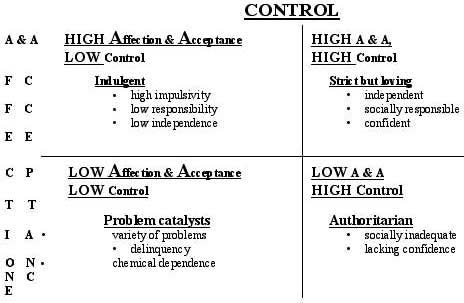
Indeed, Part III of her book The Shelter of Each Other is entitled: "Solutions: What will survive of us is love." In this she is in agreement with Cassidy (Macro model #3). The following matrix responds to Mary Pipher's question: "Under what conditions will young men and women flower and grow?"
- Using a set of for personal scripts for selftalk,
or internal-dialogues, can produce outcome goasl of developing a sense
of learned optimism, not learned helplessness, which in turn enables
one to raise one's Adversity Quotient. The higher the AQ the easier
and more successful one will be in overcoming adversity. The clue
concept is that of self-talk, of which there are several models, which
are discussed in Appendix C. All of them can be subsumed under
Paul Stoltz's concept with the book title of the same name: Adversity
Quotient: Turning Obstacles into Opportunities. Stoltz notes
that the American Psychological Association considers the "learned
helplessness" concept of Martin E.P. Seligman, as "the Landmark
Theory of the Century." It explains why people give up or
stop short when faced with life's challenges. This theory suggests
that the shooters at Columbine felt helpless despite their affluence.
The concept "Learned Helplessness" is the personal thought
process of "simply internalizing the belief that what you do does
not matter." The old wisdom statement is "As a man thinketh,
so is he." Stoltz has created two ways of using self-talk
(again, see Appendix C) to be positive, optimistic, and tackle any challenge.
These two are CO2RE and LEAD.
To Stoltz, adversity is like a mountain to climb (a "vertical" version of the "horizontal" version of running a marathon). Three types attempt the climb: quitters, who either don't start or who quit soon after starting; campers, who climb for a while and then pitch their tents hoping for conditions to change that they prefer, and just keep waiting, and climbers, who continue, no matter what, to the top. Stoltz's goal for us: to each develop and nurture as high an AQ behavior as possible, to grow a high AQ culture in every organization or group in which one participates, and to thereby each is emailed tpunleash each of our full potential. The key question (p. 281): "How important is it for you to strengthen your AQ and your ability to climb through adversity?" Like Stoltz, we all want to achieve Seligman's "Learned optimism" as a way to change beliefs such that one can see that it does matter what they try, and that they also matter. Stoltz has three key terms:
CO2RE LEADing Vision
Learn CO2RE (p. 115) and LEADing (p. 154) to create a climbing culture, and develop the Vision (pp. 284-5) needed to sustain it. Teaching AQ to others gives them a great gift: the ability to confront challenge after challenge
C = Control: focus on what you can control, not what you cannot control
O2 = Origin and Ownership (how did it start; what is your part of the solution)
R = Reach (goal: don't allow catastrophising to spill over into other areas)
E = Endurance (to reduce how long the adversity will last)
L = Listen to your adversity response: high or low?
E = Explore all origins and your own ownership of the result
A = Analyze the evidence (regarding whether you have no control, regarding if it really must
reach other areas, and regarding whether it really has to last a long time)
D = Do something! (act).
p. 155: "The LEAD sequence is based on the notion that anyone can alter their success by changing their habits of thought. Change is created by disputing old patterns and consciously forming new ones."
Proverbs 29:18: "Where there is no vision, the people perish." Stoltz says that to overcome adversity in a sustained way, one must first dream the dream, then make the dream into a vision, and then sustain the vision, hold on to it, and not let it go. P. 287: "AQ is not a quick fix, but rather an enduring formula built on a fundamental truth that life is hard--but how you handle it determines your destiny." Recall the discussion above of Frankl: even though life is filled with suffering, guilt, and death, individuals can still derive meaning from their pain and suffering. Because of vision, people know the joy of "life is beautiful: "As long as one is alive, they can ascend." - The model "Managing Conflict for Individual
& Team Success At Home and At School," presented to the Wilson
Cluster Parent Connection, May 13, 1997, by Sam Imperati, Executive
Director for The Institute for Conflict Management, Inc., and JoAnn
Hjouck, Mediator, Solomon's Tree. This model begins with the reality
that "conflict arises in all relationships," that conflict
arises when someone insists they are right and you are wrong, and that
the goal is to avoid the "standard" model, stated tongue in
cheek, of "I'll listen to your unreasonable demands if you'll consider
my unacceptable offer," and that to succeed in conflict resolution,
even between two people, those involved must act as a team even when
they come from different places/organizations/families/schools, etc.
And although not a replacement for the traditional legal process, it
can compliment it by providing a creative, economical and effective
alternative to expensive law suits. This means that those in conflict
but build relationships, not a case, and that they must understand that
they are to fix a problem not fix blame.
This model has four steps: - Identify the problem by getting both sides to understand what the other's position(s) and argument(s) is/are and to recognize that they can solve the problem.
- Explore the problem by looking at the underlying values, needs, and interests of each party, identifying what each has in common, and then exploring the best case-worst case scenarios regarding the consequences of not reaching a resolution.
- Develop solutions by listing all possible solutions, and then exploring the options in terms of which solutions satisfy common interests (O.P.T.I.O.N.S.: only proposals that include others' needs succeed).
- Select and implement a solution by negotiating a winning solution
that will generate full support now and in the future, and not ending
without laying out procedures to follow if what is worked out worsens
or, for whatever reason, the agreement reached is not working.FIFTH:
the Lists/Recipes for empowering both sides to achieve success model,
compiled by Peter J. Jessen. As human beings have no instincts
for social interaction (Berger's phrase), they "create instinct
substitutes" (Gehlen's phrase).
They create habits. These habits are said to follow the recipes needed for success. People seek "recipe knowledge" (Schutz's phrase).
It derives from three concepts:
- the social fact that humans have no instincts for human interaction nor for keeping track of things, and that to survive, must create "instinct substitutes," which are call roles. Every situation in which any person finds themselves, is a stage, and each stage has its own called for role playing, behavior, costume, etc. No one can live a role free existence.
- because of this, anyone can, individually and collectively, be a playwright and participate in creating the stages on which they play, and the plays in which they play their roles.
- individuals are capable of not only living in multiple
realities AND are capable of emigrating freely back and forth between
them. Nothing, therefore, is inevitable. All can be
negotiated, worked out (except in those cases where individuals
or groups choose not to. This also means that role playing
is more important than one's feelings, that no matter how one feels,
the old theatre adage that "the show must go on" is far
more prevalent as a reflection of the realities of life than "when
I get energized and feel great" I will get going. This
must be the attitude of any who would overcome adversity and anyone
who would engage in the "school mission marathon" to answer
the questions before us, let along the attitude that must be in
the heads of both students and teachers/administrators, if all of
them are to get the most out of the K-12 educational experience
marathon. Lists/recipes for action are key to organizing the
thoughts and actions one needs to achieve goals.
Some of lists include those of Stephen Covey's "7 Habits Habits of Highly Effective People and Families," Benjamin Franklin's list of 13 areas for achieving personal and professional success, the list of Dale Carnegie's success principles, the list of success principles of Napoleon Hill and W. Clement Stone, 6 lists for goal setting by Zig Ziglar, Tony Robbins, Robert Schuller, Peter Daniels, Paul Stoltz, and Napoleon Hill, as well as a list of books of lists by Sam Deep and Lyle Sussman.
- The Lists/Recipes for empowering both sides
to achieve success model, compiled by Peter J. Jessen. As human beings
have no instincts for social interaction (Berger's phrase), they "create
instinct substitutes" (Arnold Gehlen's phrase). They create habits.
These habits are said to follow the recipes needed for success. People
seek "recipe knowledge" (Alfred Schutz's phrase).
It derives from three concepts: (1) the social fact that humans have no instincts for human interaction nor for keeping track of things, and that to survive, must create "instinct substitutes," which are call roles. Every situation in which any person finds themselves, is a stage, and each stage has its own called for role playing, behavior, costume, etc. No one can live a role free existence. (2), because of this, anyone can, individually and collectively, be a playwright and participate in creating the stages on which they play, and the plays in which they play their roles. (3), individuals are capable of not only living in multiple realities AND are capable of emigrating freely back and forth between them. Nothing, therefore, is inevitable. All can be negotiated, worked out (except in those cases where individuals or groups choose not to.
This also means that role playing is more important than one's feelings, that no matter how one feels, the old theatre adage that "the show must go on" is far more prevalent as a reflection of the realities of life than "when I get energized and feel great" I will get going. This must be the attitude of any who would overcome adversity and anyone who would engage in the "school mission marathon" to answer the questions before us, let along the attitude that must be in the heads of both students and teachers/administrators, if all of them are to get the most out of the K-12 educational experience marathon. Lists/recipes for action are key to organizing the thoughts and actions one needs to achieve goals. Some of lists include those of Stephen Covey's "7 Habits Habits of Highly Effective People and Families," Benjamin Franklin's list of 13 areas for achieving personal and professional success, the list of Dale Carnegie's success principles, the list of success principles of Napoleon Hill and W. Clement Stone, 6 lists for goal setting by Zig Ziglar, Tony Robbins, Robert Schuller, Peter Daniels, Paul Stoltz, and Napoleon Hill, as well as a list of books of lists by Sam Deep and Lyle Sussman.
- The "Love each other" model, as admonished
by Jesus, the Buddha, and sometimes Mohammed, is a universal, regardless
of religion. Hannah Arendt says the human condition requires forgiving
others, as words and deeds are irreversible, and keeping promises, as
that keeps chaos at bay. Christians celebrate the Jewish Passover
as Maundy Thursday (Maundy having roots from three languages:
derived from mandatum, Latin, "commandment"; also derived
from the English, "Mandate"; and derived from the French,
"Mande," meaning "command" or "mandate").
For some, it refers to Jesus foot washing of his disciples and His command
to serve one another. To others it refers to his command to love
one another (both of which are common to all peoples of the Book:
Christians, Jews, Moslems). To me it refers to and includes both.
Or, as the liturgy at http://www.rockies.net/~spirit/sermons/s-maundy-thursday.html
states it:
MAUNDY is an English form of the Latin word for commandment. The overarching theme of Maundy Thursday is Jesus' new commandment, given on this the eve of his death, to "love one another even as I have loved you" (John 13:34) Maundy Thursday is the night of the final meal that Jesus had with his disciples. The night in which he washed his disciples feet, saying after he had done so: (John 13:12-17) "Do you understand what I have done for you? You call me 'Teacher' and 'Lord,' and rightly so, for that is what I am. Now that I, your Lord and Teacher, have washed your feet, you also should wash one another's feet. I have set you an example that you should do as I have done for you. I tell you the truth, no servant is greater than his master, nor is a messenger greater than the one who sent him. Now that you know these things, you will be blessed if you do them.
What makes the events of 9/11/01 so mystifying for many, is that all three religions who share and are all three called "The Peoples of The Book," Judaism, Christianity, and Islam, have members with different interpretations and who thus have adopted roles not of loving and serving but of hating and killing.
- The "Serve others model", as admonished
by Jesus, the Buddha, and Mohammed. Albert Schweitzer said:
"I don' know what you will do in life, but I do know you won't
be happy until you learn to serve others."
- Putting top individuals of conflicting organizations in the anchoring environment of a Round Table, as was used by King Author for his Knights of the Round Table, in order to get them to act cooperatively together, and as was used by Katherine Graham, Publisher of The Washington Post, to foster open communications where suspicioned communications existed before. (just as its counter part, in macro, is on a formal basis).
- The forgiveness model for reconciliation of Jewish scholar, Hannah
Arendt.
In Macro #5 above, we read: In her book, The Human Condition, the Jewish scholar Hannah Arendt says we keep chaos at bay by keeping promises and that we deal with the irreversibility of our words and deeds through forgiveness, that forgiveness and reconciliation are not the provenance of Christians, although Jesus emphasizes it more than anyone, but rather that both are necessary because of the "human condition." To forgive in order to be reconciled requires loving. Love is what is missing in the Middle East's Oslo Accords. Without love, it will ultimately fail.
We are also reminded in Micro #6 of Hannah Arendt's insight that the human condition is such that we are not perfect, and that we do and say things we wish we did not say or do. Once said or done it is irreversible. Therefore, all we can do if we want to stay in positive human relationships is to reconcile through forgiveness. Apologizing also helps. The best reconciliation comes when whoever should be apologizing does and who ever should be forgiving does. But if there is no apology, forgiveness is still required to be a human being free of the oppression of anger and holding grudges against others. Why? Because, again, words and deeds are irreversible.
Confessing and forgiveness are easier when we keep our promises, as that, she says, helps to keep chaos at bay. This fits handily with Archbishop Tutu's Ubuntu Theology of Forgiveness model (Macro #9). Too often we hate first and stay that way and thus love gets lost, and the chances of reconciliation are lost as well, causing fights among individuals at the micro level and war between countries at the macro level. Ironically, those most often calling for peace (think of the anti-war movement regarding our Civil War or regarding Vietnam or Iraq) or calling for people to do good (think of the far right attacks against Bill Clinton and the far left attacks against George W. Bush). Arendt says it is too bad that forgiveness is seen as a Jesus thing, as all peoples, all cultures, all religions need to be in reconciliation, as it is part of what is needed to deal effectively with the human condition of imperfection.
Jesus, she said, just said it best. Those who can't forgive cannot be reconciled and those who can't or won't be reconciled can't or won't love, and set the stage for continued conflict. Conflict resolution requires reconciliation which is always easier when there is at least an element of love involved. And love, admonished Jesus (and sometimes Buddha and Mohammed), is what makes harmony among people and peoples possible. This, along with others is a sober and clear-sighted example of spiritual politics at its best. Best rule? The Golden Rule.
An excellent source of "lists/recipes" is any program based on "six sigma", the concept behind the concept of TQM (total quality management), which is to minimize errors and, thus, defects. Although designed for organizations as a whole, it also designed for use individually, and can be used by such disparate organizations as manufacturing plants and public schools.
A "P.S." to these 8 macro and 8 micro models for conflict
resolution
Note that the 2 KEYS to all of these 18 models is their organization.
It is recommended that their organizational principle be that of (1) L-I-S-T-S/R-E-C-I-P-E-S)
(as part of goals, plans, contingencies, time lines), and (2) c-o-l-l-a-b-o-r-a-t-I-o-n
(with all as negotiable).
As Berger further points out, social scientists talk about the reality that "every society has its own corpus of officially accredited wisdom, the beliefs and values that most people take for granted as self-evidently true." In terms of education, there are multiple realities involved, each viewing education differently, from the unique position of its own prism of reality. This was not the case "in the old days", when, as Berger writes: "Every human society has institutions and functionaries whose task it is to represent this putative truth, to transmit it to each new generation, to engage in rituals that reaffirm it, and sometimes to deal (at least in words) with those who are benighted or wicked enough to deny it." This used to be an easy task when there was a dominant set of beliefs and values that everyone took for granted. But modern society is pluralistic, with multiple realities or worldviews that change, hence the saying of W.R. Inage, that "he who would marry the spirit of the age soon becomes a widower."
There are two other organizing principles which recommend for consideration by both the macro models and the micro models, both suggested by Peter Berger. The first is a "calculus of meaning" and a "calculus of pain," from his book Pyramids of Sacrifice: Political Ethics and Social Change, in which he suggests that policies should be those which provide the most meaning and the least pain, and that each calculus include a list of outcomes that are not desirable, in order to avoid the mistake of believing because the intent is pure, so will be the outcome.
Secondly, adapting from another analytical framework of Peter Berger, it is recommended that each of the stakeholders in the discussions that ensue review whether or not they are arguing from an ideological position or not, whether they are actually flexible with their thinking, and to ascertain whether or not they are being "historically specific conservatives" or "historically non-specific conservatives."
This eliminates the argument over content labels (liberal vs. conservative, Democrat vs. Republican), and instead focuses on the process. In this way, it can be state that both the radical left and the radical right are, hopelessly and romantically, historically specific conservatives. The radical left looks forward to a future putative utopia which, when reached, is to be frozen in place, never to change, because utopia has been achieved. The radical right looks backward to a putative golden age which it wishes to resurrect, after which it too is to be frozen in place, as the golden age has been retrieved.
The historically NON-specific conservative recognizes yet resists the impulse to fine a "good place" and to then rest and keep it that way, but also recognizes that it is better to make haste slowly, and that as most historical actions have unintended consequences, one needs to be slow in assuming that a proposed policy or action is the solution. The Spanish Civil War, which, like all wars, was a conflict "full of moral ambiguities, with unspeakable brutality on both sides," in which a monument has been erected to the million who died, a monument placed inside a mountain not far from "The Valley of the Fallen".
Berger's chilling words about this should give us all pause and inspire us to be "historically non-specific conservatives": "And the Spain that is now emerging has nothing to do with what either side fought and died for." Or, as Cassidy put it in his book, "Apartheid and all its works will pass away. So will every answer which replaces it, whether better and nobler or yet more sinful and worse."